Understanding the warning signs in the first months after transplantation — and why the differential diagnosis is decisive for graft survival.
In brief. The risk of acute rejection is concentrated in the first three to six months after kidney transplantation. Four signs call for immediate contact with the transplant team: fever, falling urine output, pain over the graft, and sudden hypertension. But these symptoms closely resemble those of BK virus reactivation — and the treatments point in opposite directions.
Acute rejection in the early months
Kidney transplantation remains the best treatment for end-stage renal disease in terms of quality of life and survival. But it exposes the patient to a constant and early risk: acute rejection of the graft. The recipient’s immune system, even under heavy immunosuppression, can recognise the transplanted kidney as foreign and attack it.
The highest-risk period falls within the first three to six months, peaking in the first weeks. Beyond that, risk decreases but never disappears entirely: late rejection can occur years later, often linked to poor adherence to immunosuppressive therapy or to the emergence of anti-HLA antibodies directed against the graft.
Several forms are classically distinguished:
- Hyperacute rejection — rare today thanks to pre-transplant cross-matching, occurring within minutes or hours.
- Acute cellular rejection — T-cell mediated, the most common in the early months.
- Acute humoral rejection — antibody-mediated, harder to treat, linked to donor-specific antibodies.
- Chronic rejection — gradual in onset, responsible for slow deterioration of the graft over years.
The four symptoms that warrant immediate attention
A kidney graft does not have the sensory innervation of a native kidney. Acute rejection can therefore progress silently in its early stages, without pain or dramatic signs. This is why close biological monitoring — serum creatinine, immunosuppressant trough levels — remains central. But when the following signs appear, they should prompt immediate contact with the transplant team.
1. Unexplained fever
A temperature above 38°C with no obvious infectious cause may signal acute rejection — or an opportunistic infection favoured by immunosuppression. Any persistent fever in a kidney transplant recipient is urgent and requires specialist assessment.
2. Falling urine output
A clear reduction in urine output — less frequent voiding, reduced volume, darker urine — reflects an abrupt fall in graft function. It is among the most specific signs of acute renal distress and should trigger emergency review.
3. Pain over the graft
Pain or a sensation of heaviness in the iliac fossa, where the graft is implanted, most often on the right, can indicate inflammatory oedema of the transplanted kidney. The area may become tender to palpation, or warm.
4. Sudden hypertension
A rapid rise in blood pressure, poorly controlled by usual medication, can reflect graft dysfunction. Transplant recipients are encouraged to measure their blood pressure at home; any sudden increase should be reported.
Other signs may accompany these: swelling of the lower limbs, rapid weight gain from fluid retention, unusual fatigue, nausea. None of them is pathognomonic of rejection in isolation, and all justify urgent medical advice.
The diagnostic challenge: acute rejection or BK virus nephropathy?
Here lies the fundamental difficulty of post-transplant follow-up. The symptoms of acute rejection and those of BK virus nephropathy are nearly identical. Both present with rising creatinine, sometimes fever, sometimes reduced urine output. Yet their treatments run in opposite directions.
| Criterion | Acute rejection | BK virus nephropathy |
|---|---|---|
| Mechanism | Immune attack on the graft | Viral reactivation favoured by immunosuppression |
| Main window | First 3 to 6 months | First 6 to 12 months, peaking around months 6 to 9 |
| Symptoms | Fever, pain, oliguria, hypertension, raised creatinine | Often asymptomatic at first, then raised creatinine |
| Treatment | Increase immunosuppression — IV corticosteroids, antibodies | Reduce immunosuppression |
| Risk if misdiagnosed | Graft loss within days | Worsening viral replication, progressive graft damage |
Today the differential diagnosis rests on BK virus PCR in blood and urine, performed in a specialist laboratory, and on graft biopsy where doubt persists or deterioration is rapid. Turnaround time for PCR varies between centres and depends on whether samples are batched.
That waiting period is the weak link. Between clinical suspicion and the PCR result, the patient sits in a zone of therapeutic uncertainty where each decision could be right — or damaging.
Where rapid testing fits
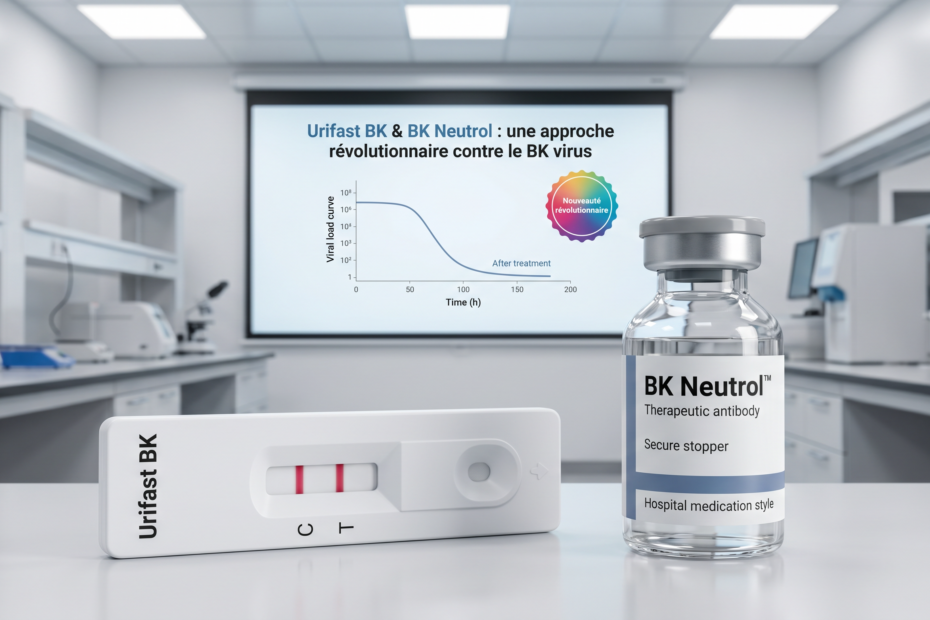
Shortening the interval between clinical suspicion and therapeutic decision is the point of rapid urinary testing. UriFastBK is a lateral flow test designed to detect BK virus in urine within minutes, at the point of care, to orient the team towards the right hypothesis without waiting for laboratory PCR. It does not replace reference testing; it provides immediate direction. Published data are on the performance page.
In parallel, BKNeutrol is a bispecific antibody programme aiming to control viral reactivation without lowering immunosuppression — and therefore without exposing the graft to rejection risk.
What to do if symptoms appear
- Contact your transplant team immediately, using the on-call number given to you at discharge. Do not wait until the next day.
- Never stop your immunosuppressive therapy on your own initiative, even with fever or suspected infection.
- Keep careful track of your blood pressure, weight and urine output. Note any variation.
- Attend all scheduled blood tests. Serum creatinine is the best early indicator of graft distress, often before symptoms appear.
- In a life-threatening emergency — inability to pass urine, severe pain, temperature above 39°C, collapse — contact your local emergency services.
Frequently asked questions
When does the risk of acute rejection decrease?
Risk is highest in the first three to six months, peaking in the first weeks. Beyond the first year, acute cellular rejection becomes markedly less likely, but humoral rejection risk persists, particularly in patients who have developed anti-HLA antibodies. Monitoring remains lifelong.
Does fever always mean rejection?
No. In a kidney transplant recipient, fever can indicate rejection but more often reflects a bacterial, viral or opportunistic infection favoured by immunosuppression. This is exactly why rapid differential diagnosis matters.
Why is BK virus a problem specific to kidney transplant recipients?
BK virus is a polyomavirus present latently in most of the adult population. In an immunocompetent person it stays silent. Under immunosuppression it can reactivate and infect the graft directly, causing BK virus nephropathy, which affects roughly 5 to 10% of kidney transplant recipients and can lead to graft loss if not detected in time.
Is UriFastBK available in routine clinical practice?
No. UriFastBK is in development. Market availability depends on completing performance studies and obtaining CE-IVD marking. For scientific enquiries or clinical partnerships, contact SPyDiag directly.
Can acute rejection be prevented?
There is no absolute prevention, but the strongest protective factors are strict adherence to immunosuppressive therapy, regular biological monitoring of creatinine, immunosuppressant trough levels and anti-HLA antibodies, and early reporting of any unusual symptom. Keeping to the post-transplant appointment schedule is essential.
UriFastBK is an in vitro diagnostic medical device under development and is not commercially available. BKNeutrol is a therapeutic candidate at the preclinical stage. Neither should be regarded as an available treatment. SPyDiag — SAS, 15 place Michelet, 37000 Tours, France.