Skip to content
Accueil » Archives pour Spydiag

Spydiag

Rejet aigu après greffe rénale risques, symptômes d'alerte et place du diagnostic rapide

Acute rejection after kidney transplantation: warning signs

Understanding the warning signs in the first months after transplantation — and why the differential diagnosis is decisive for graft survival. In brief. The risk of acute rejection is concentrated in the first three to six months after kidney transplantation. Four signs call for immediate contact with the transplant team: fever, falling urine output, pain over the graft, and sudden hypertension. But these symptoms closely… Read More »Acute rejection after kidney transplantation: warning signs
Fighting BK virus after a kidney transplant

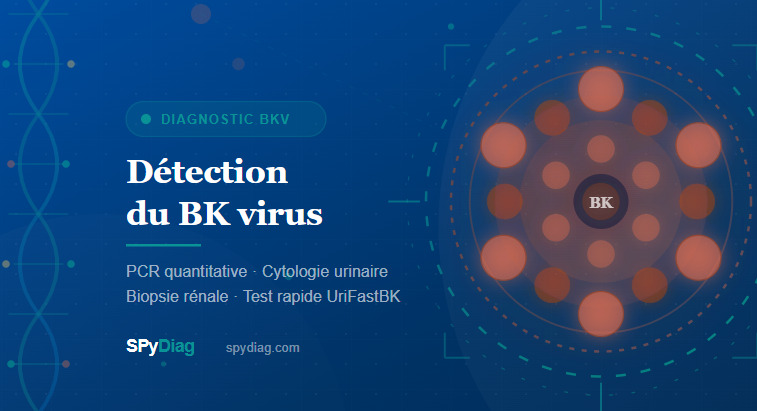
In brief. No specific antiviral against BK virus exists today. Faced with reactivation, nephrologists have a single lever: reduce immunosuppression so the patient’s own immunity can contain the virus — at the risk of triggering graft rejection. BKNeutrol, the drug candidate developed by SPyDiag in Tours, inverts that logic. It is a bispecific antibody directed against the VP1 capsid protein, designed to neutralise genotypes I… Read More »Fighting BK virus after a kidney transplant

Comment détecter une infection virale liée au BK virus ?

How is BK virus infection detected? A complete guide

Around 80% of the world’s population carries BK polyomavirus in a latent state. In immunocompromised patients — kidney transplant recipients above all — reactivation can lead to a severe nephropathy. This guide covers the reference diagnostic methods, the thresholds that matter, and where rapid testing fits. Understanding BK virus BK polyomavirus (BKPyV) is a non-enveloped human polyomavirus with a circular double-stranded DNA genome, first described… Read More »How is BK virus infection detected? A complete guide

Virus BK - vers la fin des rejets de greffe rénale Spydiag va bientôt changer la donne

BK virus: towards fewer kidney graft losses

After a kidney transplant, BK virus can reactivate under immunosuppression and threaten the graft. SPyDiag’s aim is to make screening more accessible and to open a specific therapeutic route — two levers on the same problem. Informational content. The tools and treatments described here are complementary to hospital follow-up and to the protocols of the transplant centre. Medical decisions — which tests to run, how… Read More »BK virus: towards fewer kidney graft losses

Comment UriFastBK accélère-t-il le dépistage du BK virus chez les greffés rénaux, sans plateau PCR

How UriFastBK speeds up BK virus screening without a PCR platform

UriFastBK aims to bring BK virus screening closer to the patient, so that monitoring can be more frequent and more responsive after kidney transplantation — alongside PCR, not instead of it. The problem: PCR is reliable, but not always actionable fast enough Reactivation of BK polyomavirus (BKPyV) is a major issue after kidney transplantation. It can progress to BK virus-associated nephropathy and threaten graft function,… Read More »How UriFastBK speeds up BK virus screening without a PCR platform